%20(1).jpg)
%20(2).jpg)

%20(3).jpg)
.png)
.png)


Introduction
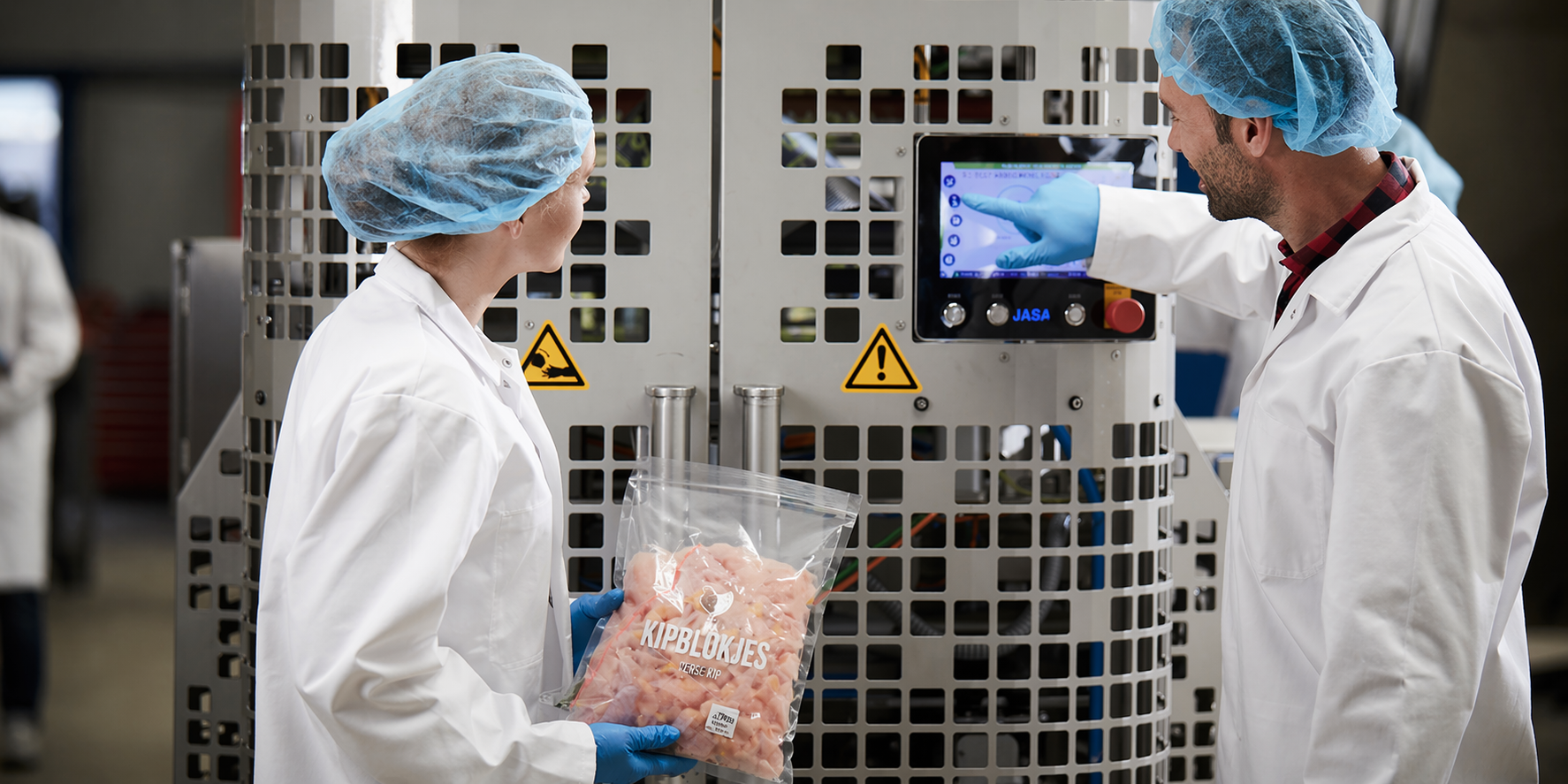
Imagine your best operator calls in sick. Or resigns. What happens to your packaging line that morning?
In many meat and fish processing facilities, critical knowledge still lives in people rather than in systems. Who knows how the line responds during a format changeover? Who knows where to adjust when throughput drops? Who knows the small tweaks that keep output on track?
That makes production dependent on experience, availability, and personal interpretation. As long as the same people show up every day on the same line, it rarely causes problems. But conditions in the industry are shifting: the labor market is under pressure, product variety is increasing, and retailers expect the same result day in, day out.
In this article, we look at where operator dependency concretely arises on your packaging line, and what changes when processes lead instead of people.
What Happens When Your Best Operator Isn’t There?
The impact is immediate. Setups take longer because the replacement has less routine. Errors occur more frequently because the experience of reading small signals is missing. Output drops, not because the machine is different, but because the operation is less confident. And downtime increases because issues are identified later or handled differently.
These are not exceptions. This is what happens in practice when knowledge lives in people’s heads rather than in the process, on every line, in every shift.
Where Your Packaging Line Depends on People
Operator dependency doesn’t appear in just one place. It’s distributed throughout the process, showing up at recurring moments:
Situation 1: Format changeovers don’t run the same way twice
During a format changeover, for example, from a 10 oz to a 17-oz pack, the result depends heavily on who performs the changeover. Differences in sequence, settings, or procedure mean the line starts up slightly differently every time. There is no standard: every operator does it their own way. In environments where changeovers need to happen faster and faster, that inconsistency shows up directly as lost time and product rejects.
Situation 2: Settings are not locked in
Manual corrections are the norm. One operator adjusts the seal pressure slightly, another tweaks the conveyor speed. Each adjustment works, for that person, at that moment. But there is no fixed reference point: the next shift starts from scratch. That costs time and introduces variability that doesn’t need to be there.
Situation 3: Problems are solved ‘by feel’
An experienced operator quickly recognizes when a line starts to struggle and knows what to do. But that approach is neither structured nor transferable. The solution lives in their head, not in the system. A new hire or temp worker doesn’t have that knowledge and loses valuable production time as a result.
Situation 4: Quality is monitored visually
In the meat and fish industry, quality assessment is often still largely visual and therefore subjective. What one operator considers ‘good enough’ gets rejected by another. The result is output variation between shifts, making it difficult to guarantee consistent quality for retail customers who expect every product to meet spec every time.
Situation 5: New people immediately cost you performance
Every new team member, permanent employee, temp worker, or seasonal hire needs time to get up to speed. In meat processing facilities where workers come from diverse backgrounds and language barriers can exist, onboarding takes even longer. Training takes more time, the risk of errors is higher, and the line performs below its potential during that period. That is a structural risk, not a temporary inconvenience.
The Result: Unpredictable Performance
All of these situations together lead to one core problem: output and quality are not consistent. They vary by shift, by operator, by day.
That has consequences further down the supply chain: quality is not uniform, scaling up becomes harder, and production planning becomes less reliable. For retail customers who expect every product to arrive on time and on spec, every day, that unpredictability is a risk that ultimately lands back on you.
Why This Problem Is Growing
Conditions in the meat and fish processing sector are making operator dependency increasingly problematic. Four trends are reinforcing each other:
Labor shortages are increasing. According to Food Industry Executive, 47% of food manufacturing companies cite a lack of qualified candidates as their single biggest challenge. Unit labor costs in food manufacturing rose by 7.5% in 2024 alone (Bureau of Labor Statistics), and turnover shows no signs of slowing.
Product variety is expanding. More SKUs, smaller batch sizes, and shorter turnaround times mean more changeovers, and therefore more opportunities for variability to enter the process.
Speed requirements are rising. Retailers expect shorter lead times and higher reliability. That increases the cost of every production error.
Experience levels are declining. Due to turnover and labor shortages, facilities are operating with less experienced people. Knowledge that was once taken for granted now needs to be actively embedded in the process.
A process that runs well today with the right people becomes vulnerable the moment those people are no longer there, or are different people. That’s exactly what we at JASA encounter in conversations with meat and fish processing companies every day: the line runs fine, but continuity is at risk.
What Changes When Processes Take the Lead
When processes lead instead of people, the foundation of production shifts. Settings are recorded and applied consistently. Changeovers follow a fixed structure. Deviations are not just resolved; they are logged and structurally prevented.
The result: less variability, more predictability, and better scalability. Operators continue to play a critical role, but as guardians of the process, not carriers of it.
These are not large overhauls. They are targeted optimizations: fixed recipes, locked-in settings, structured troubleshooting, and measurable quality criteria. Each one makes the line more robust regardless of who is running it that day.
Conclusion
Many packaging lines in the meat and fish industry perform well, as long as the right people are there. The question is whether your process does the same without that dependency.
Labor market pressure is not easing. Product variety is increasing. And retailers expect the same result every single day. That calls for a line that performs based on the process, not based on whoever happens to walk through the door that morning.
Want to know where your packaging line is still dependent on operators?
Download the free checklist and map out in 10 minutes where the biggest risks are, step by step, process by process. No sales pitch, just a practical tool to start the internal conversation.